Guglielmo Maggini | Nel tuo affondare, la mia forma | Z2O Sara Zanin
May 12 – July 10, 2026
z2o Sara Zanin is pleased to present Nel tuo affondare, la mia forma [In your sinking, my form], a solo exhibition by Guglielmo Maggini, curated by Giuseppe Armogida, engaging with the gallery’s space at Via Alessandro Volta 34.
As early as 1983, in The Ruin of Kasch, Roberto Calasso wrote “For we who are living at this moment, the most exact and most acute sensation is one of not knowing where we are treading from day to day”. This insight seems to have become a widespread experience today. In the “unnamable present,” the ground has become unstable: lines split, fabrics fray, perspectives waver. We find ourselves at a threshold where inherited ways of life have lost their substance without any others having yet taken shape.
It is as if the future had changed direction: it no longer unfolds before us as a promise, but recedes, curves backward, and becomes opaque, hard to imagine. At the same time, the past has stopped providing foundation. The result is a state of suspension in which the ideas and values that once guided our experience continue to exist only as names, having lost their weight, their hold, their effectiveness.
In this situation, the relationship between what has been and what may come must be redefined, not in order to restore some lost order, but rather to transform and revive what we have inherited instead. This is where art reveals itself as a practice of migration: in the face of catastrophe, the imagination is capable of conceiving an “otherwise”, a space in which to produce new worlds, new ways of life, new possibilities.
This is what Guglielmo Maggini enacts. His works do not merely inhabit the twilight of an era. They move, in fact, to the exact point at which something falls apart and, in that moment, begins reorganizing itself. They show no sense of nostalgia for lost origins, much less any temptation to wipe the slate clean. On the contrary, they appear to pose a much more demanding question: what forms can emerge from such remains?
In this, Maggini appears as both cosmonaut and translator: crossing worlds, connecting them, transporting forms from one time to another, one context to another, reinterpreting them and making them legible once again. This is the movement that informs Nel tuo affondare, la mia forma, a previously unseen body of works presented through a narrative that is only apparently linear, given that the exhibition lends itself to a reading that may begin at any point along the route.
From the outset, the exhibition opens as a diving into open water. Visitors are greeted by a ceramic sculptural group, Re Mida [King Midas] that recalls a figure resurfacing from the depths. The work is part of the artist’s long-standing exploration of the relationship between fathers and sons—the heart of craftmanship, its embodied form of transmission—and continues the effort undertaken at the historic Fumanti artisan workshop in Gubbio where Maggini delved into the archive of plaster molds for liquid clay—now no longer used—in search of fragments of productive knowledge rendered obsolete by today’s economy.
From these remains, he generated new forms and recomposed them into an unexpected constellation that golden luster illuminates in submerged light. Corals, inflorescences, concretions seem to emerge from the seabed and echo a lost golden age, a sunken Atlantis. King Midas—the one who touches and by touching destroys everything and transforms all into precious metal—becomes a parable of our time: the hand that creates and decorates is also the one that consumes, separating forms from their original life until they are transformed into gilded archaeology.
The past appears here not as static foundation but rather as a living reservoir of forms and images that permeate and enable the present. Maggini explores his origins, the traces of the Others who have shaped him. He searches for his fathers and mothers, not merely gazing into the abyss of the sea but going so far as to become the sea himself, as in MaRemoto (2024)—where the riverine figure of the Nile, an elderly man reclining in melancholic expression with long, wavy hair extends like a trembling wave of ultramarine blue—to identify with that force that simultaneously generates and overwhelms, supports and submerges, in the awareness that what re-emerges is a living material that continues to vibrate with possibility from which it is still possible to begin anew.
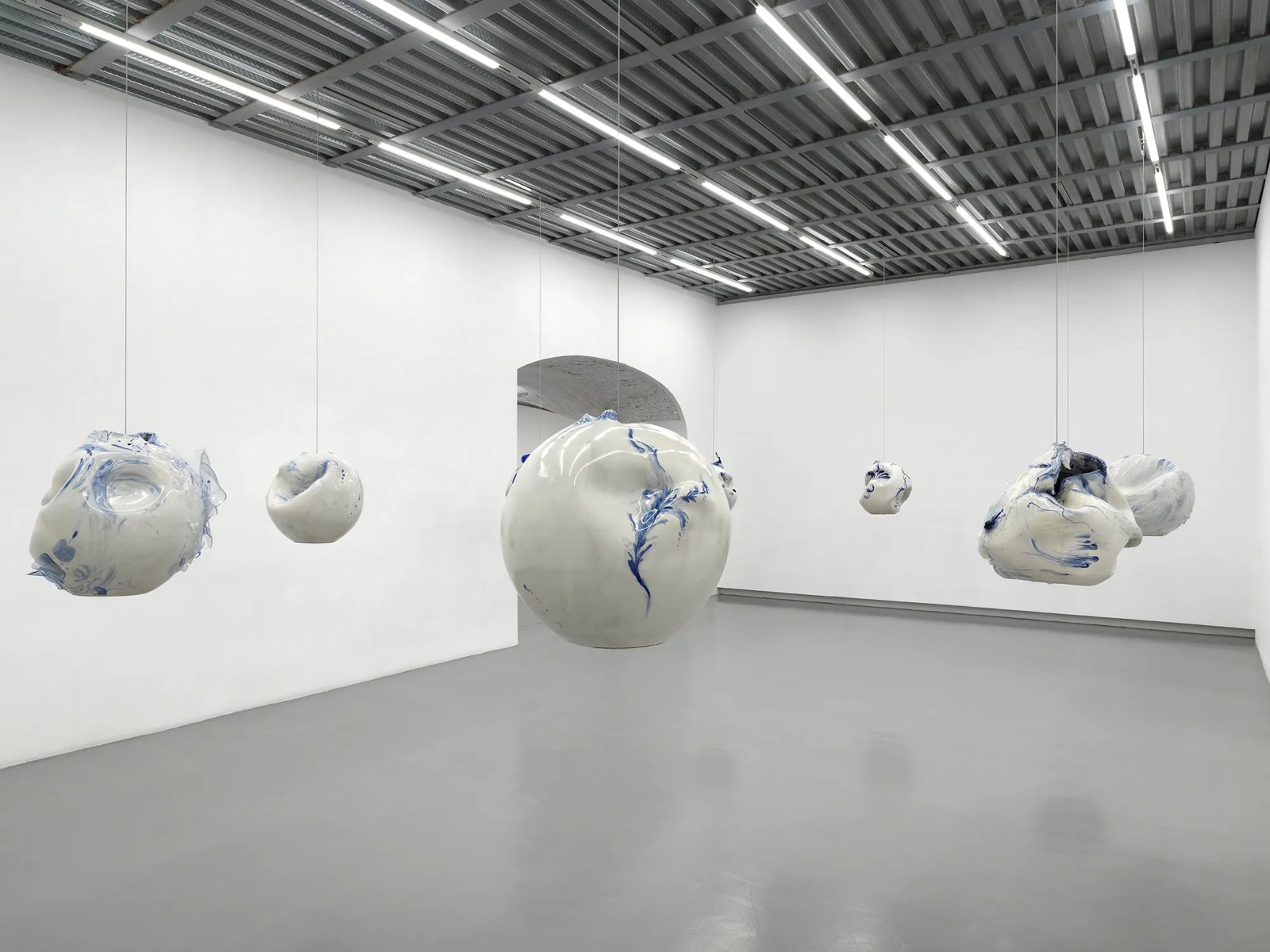
This is precisely what happens in the first room where nine spheres appear, nine Naufragi [Wrecks], each with subtitles introducing a brief narrative. As if driven by an internal pressure, these forms implode. Surfaces strain, material frays, liquefies, as if something were both yielding and reconfiguring at the same time. These spheres were created in a period of great instability, October 2025, when the artist felt the ambivalence of his position—necessary and marginal—with particular intensity.
His gesture of embrace takes shape in the friction between these two. Each sphere is fifty-six centimeters in diameter, the exact circumference his arms can enclose. The form becomes the cast of an embrace: a return to physical contact, the body’s memory, a way to hold back and traverse the images of the twentieth century before they scatter while reviving them at the same time.
From this gesture traces of layered worlds emerge in the language of ceramics developed in Central Italy presented freely without hierarchy in overlapping eras and styles. Maggini handles this heritage with painterly skill, neither referencing nor reproducing. He moves through it, mixing and twisting. Scrolls, animals, parts of plants, flowing landscapes re-emerge as incidental memories. Tides, splashes, layers of time in majolica. He then intervenes with resin to stain the surfaces with the present and lay the imprint of our era on forms that seem to have come from long ago.
In these acts of embrace, Maggini draws from the Other those traits that let him give form and meaning to his own presence in the world. Heritage becomes a journey in which the debt to those who came before must be acknowledged before navigating the void left by what is no longer there. In suspension, the spheres outline this void while simultaneously keeping it in tension: shipwrecks that neither sink nor reach the shore but remain in a state of precarious balance.
Suspended in this way, the artist’s movement comes alive to reopen passage and enable an unprecedented process of reclaiming what has, deep down, always been his. In this sense, the exhibition is also a celebration of a new beginning.
This is apparently confirmed by La cesta mistica [The Mystic Basket] at the center of the second room: a collapsed sphere of which only the lower part remains intact as the upper part has shattered into an archipelago of fragments that the artist tries to reassemble. The resemblance here is to shard generated by explosion, ambiguous forms straddling the line between bodies and vegetation. Emptiness and generation coincide: what appears as the deposition of a world contains the possibility of a backlash, if not a resurrection within itself.
The basket is, by nature, a hollow object structurally empty, elusive, almost immaterial. Yet at the same time, it is a symbol of fertility and rebirth, as in the myth of Demeter, who is often depicted with baskets brimming with snakes that mimic the folds and convolutions of female genitalia.
A world has collapsed, to be sure. But every explosion also scatters new trajectories. In the fragments arranged on the wall, as also in Ecce Homo—a barely visible glass trace in the last small room—a glimpse at the chance for a new route may be discerned. This is perhaps where Maggini’s most radical gesture is defined: not in pulling the sinking world back from drowning but in giving it form by moving through it, and then showing how new directions might emerge from what remains.
Z2O Sara Zanin
Via Alessandro Volta, 34
Roma